Showing posts with label ergonomics. Show all posts

Wednesday, 14 August 2013

Backpack safety for kids


A simple and nice video on how kids should put their backpack by moveforwardpt.com. This is an extremely important issue for the healthy development of the whole musculoskeletal system of a kid and especially its spine.

Major points:

  1. Do not use one strap backpacks
  2. Put both straps around the shoulders and adjust them so that the kid feels comfortable with it
  3. Do not allow the backpack to fall below the low back of the kid
  4. Put in the backpack only the necessary items and do not make it heavy

Good luck to all the kids with their new school year!!

Sunday, 11 August 2013

Foot analysis for runners


It is of extreme importance to have comfortable and ergonomic shoes if you are a city runner. I recently went to the Asics store in Amsterdam in order to buy a pair of running shoes. They offered me a free foot analysis before buying my runners, which I enjoyed very much. They have really good knowledge of gait analysis, especially when it has to do with city runners.

I am pointing out the major parts of the manual they gave me after my foot analysis and I add some of my knowledge in order to give you useful information on this matter:


1. Foot length

The length of your foot is measured from the end of your heel to the end of your longest toe, along an imaginary line running from the center of your heel to the end of your longest toe. For sport shoes, you should choose a size approximately 8-10 mm larger than your base foot length. This is because your feet become slightly longer in the propulsion phase o the gait cycle.

2. Ball girth (or circumference)

"Ball girth" measures around the foot, from the ball of the big toe to the ball of the little toe. Ball girth is different from foot width, which is a simple two-dimensional measurement. It is a very important measure for correct shoe fitting.

3. Heel breadth

Heel breadth is measured from the inside to the outside of the hell, at 18% of the distance of the whole foot, measuring from the back of the heel. If your heel is very narrow, you will have to place it more firmly into the heel of your shoes by tightening your laces a little more. If your heel is wide, there is no problem.

4. Instep height

Because it is related to the ball girth, instep height has a subtle effect on fitting. The place to measure the instep is roughly equal to three fingers from the base of the ankle. For example, a narrow ball girth and a high instep may not fit slim shoes.

5. Arch height

Arch height is measured by the height of the navicular bone and is directly linked to the type of arch and instep height. If your feet have low arches and your footprint shows dropped arches, you may have flat feet. Losing the basic shape of arch tends to cause more tiredness and pain.

6. Heel angle

The hell angle is the angle between the vertical line that passes through the heel and the vertical line that passes through your body center of gravity. There are two possibilities regarding the heel angle: pronation (eversion) or supination (inversion). The average is 1.5 degrees of eversion. Excessive eversion increases loading on the inner side of the foot and tiredness around the big toe. Excessive inversion increases loading on the outside of the foot decreasing stability and flexibility.

7. Toe angle

Toe angle shows the inclination of your big toe. In pathologies, it can be either valgus (outward point of the big toe) or varus (inward pointing of the big toe). Both cases have negative effects on your gait.


8. Footprints

There are two main archs in your foot, the transverse and the longitundinal arch. Depending on their height, three deformities can be distinguished:

a. Increased height of the longitundinal arch (pes cavus) - runners with high arched foot choose shoes in the under-pronator to neutral categories.
b. Loss of the longitundinal arch (flatfoot, or pes planus) - runners with flat feet should select shoes in the overpronator to severe over-pronator categories
c. Loss of the transverse arch (splayfoot, or pes tranversoplanus) - same as flatfoot runners


9. Running styles

Depending on the degree of pronation (outward movement of the foot) during running, you can be categorized in one of the three major running styles (the picture above show the right foot from behind):

a. Overpronation
 - excessive outward movement of the foot
 - more load is put on the inside part of the foot, which is transferred to the knee, hip and lower back
 - waste of energy and early fatigue
 - higher risk of injury

b. Neutral
 - balanced gait
 - efficient sock absoprtion
 - more biomechanically efficient
 - low risk of injury

c. Underpronation (or supination)
 - excessive inward movement of the foot
 - more load is put on the outside of the foot, which is transferred to the knee, hip and lower back
 - high foot arch
 - rigid foot
 - high risk of injury but very rare case

Wednesday, 24 July 2013

Proper bike posture


With biking becoming more and more famous all over Europe, it is extremely important to know how to properly set your posture.

Monday, 17 June 2013

Arm and shoulder pain in SCIs: seeking solutions


Figure 2: Pressure map images show areas of high and low pressure while seated. The colors and numbers on the screen correspond to pressure readings expressed as millimeters of mercury (mmHg).

NW Regional Spinal Cord Injury System

Many people with SCI who use manual wheelchairs develop chronic, disabling arm, shoulder or hand pain that interferes with daily life. Studies have found that between 31%-73% of persons in the SCI population have shoulder pain, and 49%-73% have painful carpal tunnel syndrome.

Despite the frequency of these syndromes, little is known about their specific causes or how to prevent them, and treatments are not always effective.

In order to unravel this mystery, the Northwest Regional SCI System at the UW Department of Rehabilitation Medicine is collaborating with two other SCI centers (University of Pittsburgh and the Kessler Institute) on a study of wheelchair propulsion and transfer techniques in the SCI population.

Wheelchair propulsion method: push or pull?


Have you ever thought that it would be better for a wheelchair user to pull instead of push in order to move forward? Would that be biomechanically better? Which muscles would be activated in each case? Is there clinical evidence that supports each case? What is the effect on the muscle soreness and fatigue as well as on cardiovascular endurance in each case?

These were the questions that made the RowWheels team to re-design and re-engineer a wheelchair from scratch. And they came up with this wheelchair in the video.


In their website: rowwheels.com you can find very usefull information on the following:

and many more...

Interesting idea which I am curious to see how it will be introduced to and supported by the clinicians and the wheelchair users.

As they mention in their website, "benefits described, though likely, are still pending validation through clinical studies".

Saturday, 15 June 2013

The Hand Foundation - improvehands.org


Who we are

The Hand Foundation financially supports applied scientific research and development of prostheses and orthoses for people with a hand or arm deficiency.

Prostheses

Worldwide there are many people who miss a part of their hand or arm. This can be caused by an amputation or by a congenital reduction deficiency. The current available hand and arm prostheses only provide a limited functionality. Furthermore using one of the current prostheses often causes several problems, e.g. the prosthesis is to heavy, or it is regularly broken. As a result half of the people with a reduction deficiency preferfs not to wear a prosthesis at all (Biddiss, 2007). This, on its turn, might result in overuse of the healthy arm.

The Hand Foundation would like to see better hand- and arm prostheses becoming available. Prostheses that are easy to operate, that are lightweight, and that are seldom broken. Therefore the Hand Foundation supports research and development of prostheses that meet the user needs.

Orthoses

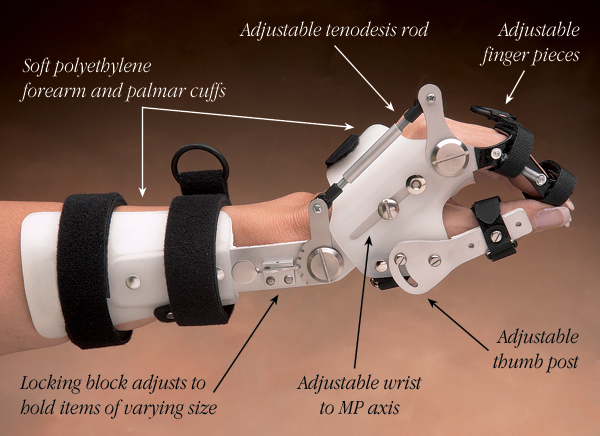
For people who do have an arm, but are not able to use it, orthoses are available. An orthosis supports the movement or positioning of the arm, e.g. in case of a brachial plexus injury. Unfortunately most of the orthoses only offer passive support. An orthosis supports the positioning of the hand. However it does not restore the grasp function of the hand.
The Hand Foundation would like to see better hand- and arm orthoses becoming available. Orthoses that have active functionality, that are easy to operate, and that are lightweight. Therefore the Hand Foundation supports research and development of orthoses that meet these user demands.

Can you grasp a pin with the Delft Cylinder Hand orthoses?


A medical researcher at TU Delft has made one of the most important recent developments in the field of prosthetics. During the course of his PhD programme, Gerwin Smit created what is now termed the "Delft Cylinder Hand."

Smit says that he was motivated by the fact that one in five of individuals who require a prosthetic limb choose not to do so. This is because of a series of problems with the current models, which includes "low user comfort (too heavy, too hot), too few functional advantages and a lack of sensory feedback."

But he may have erased this problem with his new prosthetic hand: "It's all about the three Cs: cosmetics, comfort and control. The prosthesis needs to be attractive to look at, comfortable to wear and easy to operate."

His "Delft Cylinder" model is body-powered, and has hydraulically-operated, hinged fingers. The hand can be operated more easily than current prosthetics thanks to its lightweight material, shoulder harness and miniature cylinders.

Following the success of initial trials, where participiants were able to easily use tweezers and pens, the "Delft Cylinder" will now be undergoing clinical tests, and will hopefully enter the medical market within the next five years.

For more information on the Delft Cylinder Hand, click here.


Saturday, 1 June 2013

The effect of sitting on your hip muslces


Technology and internet in our era has brought a lot of new ideas into life and has made it more fun and easier than it was before. We all love spending hours in front of our screens surfing on the web, watching our favorite YouTube videos, socializing on Facebook. or even writing articles on our favorite blog (;-).

We all know the negative effects of the sedentary life, but thank to the explosion of the health awareness movement the last years, more and more people have started changing their life style towards a more active way.

What I am presenting in this article is the effect of this sedentary life on 2 very important for a strong and healthy spine muscles - the iliopsoas and the gluteus maximus. I have already posted an article on the tendency of iliopsoan to become short and tight and the gluteus maximus to become weak (the lower cross syndrome).

Let's have a picture of these 2 muscles:

       
picture 1. iliopsoas             picture 2. gluteus maximus

It can be easily pictured, that when we sit and our hips are in flexed position, the iliopsoas muscle is in a shortened position, while the gluteus maximus is in a stretched position. This fact creates a major problem other than the obvious effect on our muscles - inequality in the pelvis position.

As it can be seen in the pictures above, both muscles originate from the pelvis. The "iliacus" part of the iliopsoas originates from the fossa iliaca and the gluteus maximus originates from the facies glutea. This means, under certain circumstances, that they both have an effect of the position of the pelvis. The iliopsoas muscle, if contracted in the standing posture, it has the fixed part on the femur and the mobile part on the spine and the pelvis. This causes a forward tilt of the pelvis. On the other hand, the gluteus maximus, if contracted in the standing posture, it has its fixed part on the femur and the mobile part on the pelvis. This causes a backward tilt of the pelvis.


As a result of all these, a shortened iliopsoas muscle and a weak gluteus maximus muscle cause a forward tilt of the pelvis, which consequently leads to a compensating hyper-lordosis of the lumbar spine. And it is this hyper-lordosis that can cause quite a few problems if it is not treated properly and soon - chronic low back pain, herniated nucleus pulposis, spondylolisthesis, sponylolysis etc.

There is also a very well know theory/approach by Dr. Vladimir Janda about the tendency of some muscles to become weak and some others to become tight.

What is important for a Physical Therapist to know after that, is some specific stretching exercises for the iliopsoas and some strengthening exercises for the gluteus maximus.

Iliopsoas stretching exercises:


Here are two typical stretching exercises one can do for the iliopsoas muscle, always with after the assessment of a Physical Therapist and with his/her assistance. In the both pictures, the left iliopsoas is stretched. It is of extreme importance for someone to do these exercises under the guidance and supervision of a Physical Therapist in order to avoid wrong posture, further tissues damage or lumbar spine hyper-lordosis.

Gluteus maximus strengthening exercises

Research presented in the Journal of Orthopaedic and Sports Physical Therapy (JOSPT) presented the best exercises for the gluteus maximus. The authors of this particular study used electromyography (EMG) to quantify and compare signal amplitude as the gluteus maximus (and gluteus medius) fired in order to determine which therapeutic exercises most effectively recruit the glutes.

The result is that the 3 following exercies are the most effective:

One-leg squat - click for the JOSPT video

One-leg deadlift - click for the JOSPT video

Sideways, front, and transverse lunges - click for the JOSPT video

Wednesday, 8 May 2013

Proper lifting for new moms


Jen DeLorenzo, PT, CFMT, discusses challenges facing news moms including proper body mechanics and how a physical therapist can help them adjust their posture and lifting technique to avoid pain and injury. To find a PT near you, visit www.moveforwardpt.com.

Saturday, 9 March 2013

Common postural diviations


Maximal range of motion across the different vertebrae regions


A very nice graph summarizing the overall maximal range of motion (in degrees) allowed across three planes, throughout the cervical, thoracic, and lumbar regions.

You can see it here.

source: Kinesiology of the musculoskeletal system, Donald A. Neumann, 2nd edition, Mosby Elsevier

Friday, 22 February 2013

Upper cross syndrome - anatomy


After presenting you my file for the lower cross syndrome, I am now presenting you a similar file for the upper cross syndrome.

A syndrome very common in students that study a lot :-))

Saturday, 16 February 2013

Lower cross syndrome - anatomy


Ok, we all know this diagram. What I was interested in doing, though, was to find the exact muscles that are important in this syndrome. So, I am presenting them with origin, insertion, action and innervation:

Go to this link.

Monday, 11 February 2013

How can you transfer patients with less effort?


Transferring a patient either in a health care unit or in his/her home is the major activities of a Physical Therapist. It is of vital importance for Physical Therapists to learn how to properly transfer patients in many different conditions in order to protect the health of both the patient and themselves.

Here is a beautiful guideline created by WorkSafeBC.

Are you working safely?


"WorkSafeBC is dedicated to promoting workplace health and safety for the workers and employers of this province. We consult with and educate employers and workers and monitor compliance with the Occupational Health and Safety Regulation.

In the event of work-related injuries or diseases, WorkSafeBC works with the affected parties to provide return-to-work rehabilitation, compensation, health care benefits, and a range of other services".

source: WorkSafe BC

They also have a beautiful YouTube channel with very useful videos here.

Sunday, 10 February 2013

Measuring and using crutches


"Walking aids are used by a variety of people. This includes people recovering from injury, people with  reduced balance strength and endurance, or people with pain or instability in any weight bearing joint used in walking.

The choice of walking aid should suit a person’s abilities and personal requirements. It is recommended to seek the assistance of a physiotherapist in this process.

A physiotherapist is also able to provide advice and training in the correct use of the device.

LifeTec Queensland is a leading provider of information, consultation, and education on assistive technology that can help individuals improve their quality of life and remain independent.

In partnership with a range of complementary organisations, LifeTec Queensland provides advice on the range of available solutions regardless of a person's age or level of ability.

LifeTec assists a wide range of people from all walks of life".


Wednesday, 6 February 2013

Do you have a correct posture in your ADLs?


Logo

With a correct posture can prevent physical symptoms. In this website you will find instructions for the correct posture at work in the nursing care and home care.

You have to use google.translate because it is in Dutch, but you can understand everything since it has many many pictures in it.

Saturday, 2 February 2013

A nice solution for people with paraplegia


Tek RMD, provides the opportunity of movement for people with paraplegia by enabling them to independently stand up in a completely upright position with correct posture, facilitating their movement and comfortable completion of their daily tasks indoors, such as in the home, office and shopping mall. Tek RMD is not an alternative to wheelchairs, it is a totally new concept, a new platform.