Showing posts with label prosthetics & orthotics. Show all posts

Saturday, 15 June 2013

The Hand Foundation - improvehands.org


Who we are

The Hand Foundation financially supports applied scientific research and development of prostheses and orthoses for people with a hand or arm deficiency.

Prostheses

Worldwide there are many people who miss a part of their hand or arm. This can be caused by an amputation or by a congenital reduction deficiency. The current available hand and arm prostheses only provide a limited functionality. Furthermore using one of the current prostheses often causes several problems, e.g. the prosthesis is to heavy, or it is regularly broken. As a result half of the people with a reduction deficiency preferfs not to wear a prosthesis at all (Biddiss, 2007). This, on its turn, might result in overuse of the healthy arm.

The Hand Foundation would like to see better hand- and arm prostheses becoming available. Prostheses that are easy to operate, that are lightweight, and that are seldom broken. Therefore the Hand Foundation supports research and development of prostheses that meet the user needs.

Orthoses

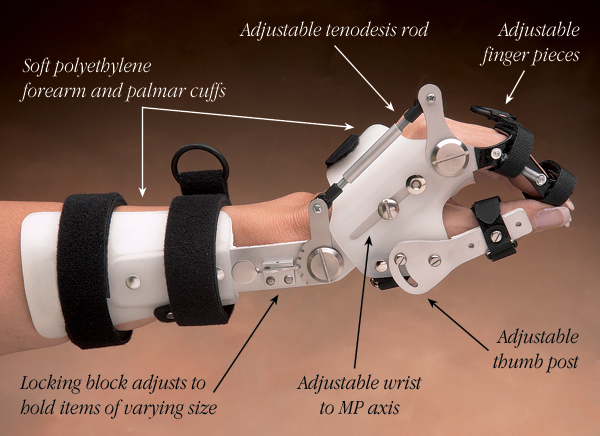
For people who do have an arm, but are not able to use it, orthoses are available. An orthosis supports the movement or positioning of the arm, e.g. in case of a brachial plexus injury. Unfortunately most of the orthoses only offer passive support. An orthosis supports the positioning of the hand. However it does not restore the grasp function of the hand.
The Hand Foundation would like to see better hand- and arm orthoses becoming available. Orthoses that have active functionality, that are easy to operate, and that are lightweight. Therefore the Hand Foundation supports research and development of orthoses that meet these user demands.

Master of Science BioMedical Engineering - TU Delft


As medical science has advanced, physicians and patients have relied on increasingly sophisticated medical devices for diagnosis, treatment, and long-term health care. Biomedical engineers are key players in the development, design, and continuing refinement of devices such as joint replacement prostheses, microsensors, imaging and image processing, as well as advanced instruments for use in such domains as minimally invasive surgery and the diagnosis of movement disorders. 

What you will learn

The TU Delft master's programme in BioMedical Engineering is a multidisciplinary programme which aims to provide you with both an understanding of biology and medical theory as well as highly specialised technical training in such fields as electrical, physics, material and mechanical engineering.

You will learn how to develop conceptual models from a technical perspective and you will work in close collaboration with physicians, researchers and other healthcare professionals, including on-site at the collaborating academic institutions.

Learning from 3 faculties and 3 teachings hospitals:

You will take courses offered by three TU Delft faculties:

  • Applied Sciences
  • Electrical Engineering, Mathematics and Computer Sciences
  • Mechanical, Marine and Materials Engineering

The programme also benefits from the clinical input provided by three teaching hospitals:

  • Leiden University Medical Center
  • Erasmus Medical Center in Rotterdam
  • Academic Medical Center in Amsterdam


Try a free course online: Biomedical Engineering

Delft Institute of Prosthetics and Orthotics


The Delft Institute of Prosthetics and Orthotics is part of the BioMechanical Engineering Department of the Faculty of Mechanical, Maritime, and Materials Engineering [Faculty 3mE] at the Delft University of Technology. Our goal is to develop and provide innovative prostheses and orthosis for the upper extremity.

The research outcome is, apart from being published, taken through a thorough process of clinical evaluation, resulting in commercially available products under the WILMER brand name.

Can you grasp a pin with the Delft Cylinder Hand orthoses?


A medical researcher at TU Delft has made one of the most important recent developments in the field of prosthetics. During the course of his PhD programme, Gerwin Smit created what is now termed the "Delft Cylinder Hand."

Smit says that he was motivated by the fact that one in five of individuals who require a prosthetic limb choose not to do so. This is because of a series of problems with the current models, which includes "low user comfort (too heavy, too hot), too few functional advantages and a lack of sensory feedback."

But he may have erased this problem with his new prosthetic hand: "It's all about the three Cs: cosmetics, comfort and control. The prosthesis needs to be attractive to look at, comfortable to wear and easy to operate."

His "Delft Cylinder" model is body-powered, and has hydraulically-operated, hinged fingers. The hand can be operated more easily than current prosthetics thanks to its lightweight material, shoulder harness and miniature cylinders.

Following the success of initial trials, where participiants were able to easily use tweezers and pens, the "Delft Cylinder" will now be undergoing clinical tests, and will hopefully enter the medical market within the next five years.

For more information on the Delft Cylinder Hand, click here.