Showing posts with label handwriting difficulties. Show all posts

Saturday, 15 June 2013

The Hand Foundation - improvehands.org


Who we are

The Hand Foundation financially supports applied scientific research and development of prostheses and orthoses for people with a hand or arm deficiency.

Prostheses

Worldwide there are many people who miss a part of their hand or arm. This can be caused by an amputation or by a congenital reduction deficiency. The current available hand and arm prostheses only provide a limited functionality. Furthermore using one of the current prostheses often causes several problems, e.g. the prosthesis is to heavy, or it is regularly broken. As a result half of the people with a reduction deficiency preferfs not to wear a prosthesis at all (Biddiss, 2007). This, on its turn, might result in overuse of the healthy arm.

The Hand Foundation would like to see better hand- and arm prostheses becoming available. Prostheses that are easy to operate, that are lightweight, and that are seldom broken. Therefore the Hand Foundation supports research and development of prostheses that meet the user needs.

Orthoses

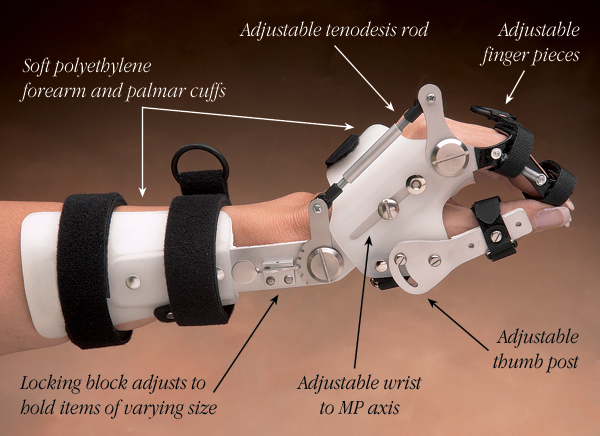
For people who do have an arm, but are not able to use it, orthoses are available. An orthosis supports the movement or positioning of the arm, e.g. in case of a brachial plexus injury. Unfortunately most of the orthoses only offer passive support. An orthosis supports the positioning of the hand. However it does not restore the grasp function of the hand.
The Hand Foundation would like to see better hand- and arm orthoses becoming available. Orthoses that have active functionality, that are easy to operate, and that are lightweight. Therefore the Hand Foundation supports research and development of orthoses that meet these user demands.

Can you grasp a pin with the Delft Cylinder Hand orthoses?


A medical researcher at TU Delft has made one of the most important recent developments in the field of prosthetics. During the course of his PhD programme, Gerwin Smit created what is now termed the "Delft Cylinder Hand."

Smit says that he was motivated by the fact that one in five of individuals who require a prosthetic limb choose not to do so. This is because of a series of problems with the current models, which includes "low user comfort (too heavy, too hot), too few functional advantages and a lack of sensory feedback."

But he may have erased this problem with his new prosthetic hand: "It's all about the three Cs: cosmetics, comfort and control. The prosthesis needs to be attractive to look at, comfortable to wear and easy to operate."

His "Delft Cylinder" model is body-powered, and has hydraulically-operated, hinged fingers. The hand can be operated more easily than current prosthetics thanks to its lightweight material, shoulder harness and miniature cylinders.

Following the success of initial trials, where participiants were able to easily use tweezers and pens, the "Delft Cylinder" will now be undergoing clinical tests, and will hopefully enter the medical market within the next five years.

For more information on the Delft Cylinder Hand, click here.


Monday, 4 February 2013

KNGF evidence statement motor handwriting problems in children


"Handwriting is a skill which allows children and adults to communicate. Although the use of computers is growing, handwriting is still worldwide an important and the most immediate tool for graphic communication. At school writing supports the learning process in other domains like reading, mathematics and history and the older children are the more they spent their time at school with writing.  If children have writing problems, this can affect negatively general school performance and self-perception. In the Netherlands over 30% of children encounter difficulties with learning to write to a greater or lesser extent.

Although learning to write is a cognitive skill, the motor component in the learning process shows a major role.  As a result, it has become common in The Netherlands that parents and/or teachers consult a paediatric physio- or occupational therapist in primary care with a request for help.

In 2009, we conducted a digital survey among all members of The Dutch Society for Paediatric Physiotherapists (acronym: NVFK), specialized member of the Royal Dutch Association for Physical Therapy (acronym: KNGF). It appeared that paediatric physiotherapists spent 25-50% of their time in children with handwriting problems. Moreover, it was clear that the variance in diagnostics and intervention methods was large. These findings stressed the clinical relevance to the development of an Evidence Statement.  Therefore, the NVFK has assigned the project group ‘Children with handwriting problems’ to develop an Evidence Statement (ES) for paediatric physiotherapists.  The objective of the ES was to achieve uniformity in indication, diagnostics and intervention".